
 English
 Español
 ไทย
ไทย Indonesia

التنظيف بالموجات فوق الصوتية
Ultrasonic cleaning is a modern and efficient method used to remove contaminants from a wide variety of objects and materials. It relies on high‑frequency sound waves, typically in the range of 20–80 kHz, transmitted through a liquid to create millions of microscopic bubbles. These bubbles form and collapse in a process known as cavitation. When they implode near the surface of an item, they generate tiny shock waves and micro‑jets that dislodge dirt, grease, oxides, and other residues, even from very small gaps and complex geometries.A typical ultrasonic cleaning system consists of a tank, a transducer, a generator, and a suitable cleaning solution. The tank holds the liquid and the parts to be cleaned. The transducer converts electrical energy into ultrasonic vibrations and is either mounted on the tank wall or immersed in the liquid. The generator provides the required electrical signal at the desired frequency and power. The cleaning solution can be plain water, water with detergents, or specially formulated solvents, depending on the type of soiling and the material of the workpiece.One of the key advantages of ultrasonic cleaning is its ability to reach areas that are inaccessible by manual cleaning methods, such as blind holes, fine channels, and internal cavities. The process is gentle enough for delicate components, yet powerful enough to remove stubborn contaminants. It is widely used in industries such as electronics, medical and dental, automotive, aerospace, precision engineering, and jewelry. Typical applications include cleaning circuit boards, surgical instruments, fuel injectors, bearings, optical lenses, and watch parts.Process parameters such as frequency, temperature, cleaning time, and chemistry must be optimized for each application. Lower frequencies generally produce larger cavitation bubbles and stronger cleaning action, which is suitable for robust parts with heavy contamination. Higher frequencies generate smaller bubbles and a more delicate action, ideal for fine or sensitive components. Heating the solution, usually to 40–70°C, improves chemical activity and helps dissolve oils and greases. Cleaning cycles can range from a few minutes to over half an hour, depending on the level of contamination.Ultrasonic cleaning also offers environmental and economic benefits. It reduces the need for harsh chemicals and manual scrubbing, lowers labor costs, and can improve consistency and quality. With proper filtration and maintenance of the cleaning solution, bath life can be extended, minimizing waste. However, safety considerations are important: operators should avoid direct contact with the liquid during operation, use appropriate chemistry for the materials involved, and ensure adequate ventilation when volatile agents are present.Overall, ultrasonic cleaning provides a highly effective, time‑saving, and versatile solution for both industrial and laboratory cleaning tasks, delivering thorough results that are difficult to achieve by conventional methods.
نتاج
تصنيف:
-
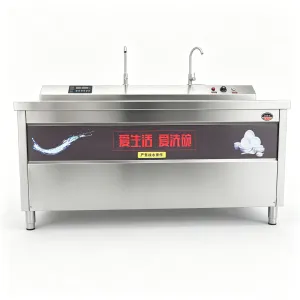
غسالة صحون بالموجات فوق الصوتية من الفولاذ المقاوم للصدأ للمطاعم والتموين
تصنيفها: سلسلة غسالة الصحونالمشاهدات: 11عدد:وقت الإصدار: 2026-04-17 15:45:13تستخدم غسالة الأطباق بالموجات فوق الصوتية المصنوعة من الفولاذ المقاوم للصدأ موجات عالية التردد للتنظيف العميق، وتزيل الزيت والبقايا بكفاءة، وتوفر الماء والمنظفات، وهي مصممة بشكل متين للاستخدام في المطاعم والمطاعم ذات الحجم الكبير.
أخبار
تصنيف:
لا توجد نتائج بحث!
حالة
تصنيف:
لا توجد نتائج بحث!
فيديو
تصنيف:
لا توجد نتائج بحث!
تحميل
تصنيف:
لا توجد نتائج بحث!
تجنيد
تصنيف:
لا توجد نتائج بحث!
المنتجات الموصى بها
لا توجد نتائج بحث!



 واتس اب
 هاتف
هاتف